GST is not just a monthly filing exercise—it is a financial control system.
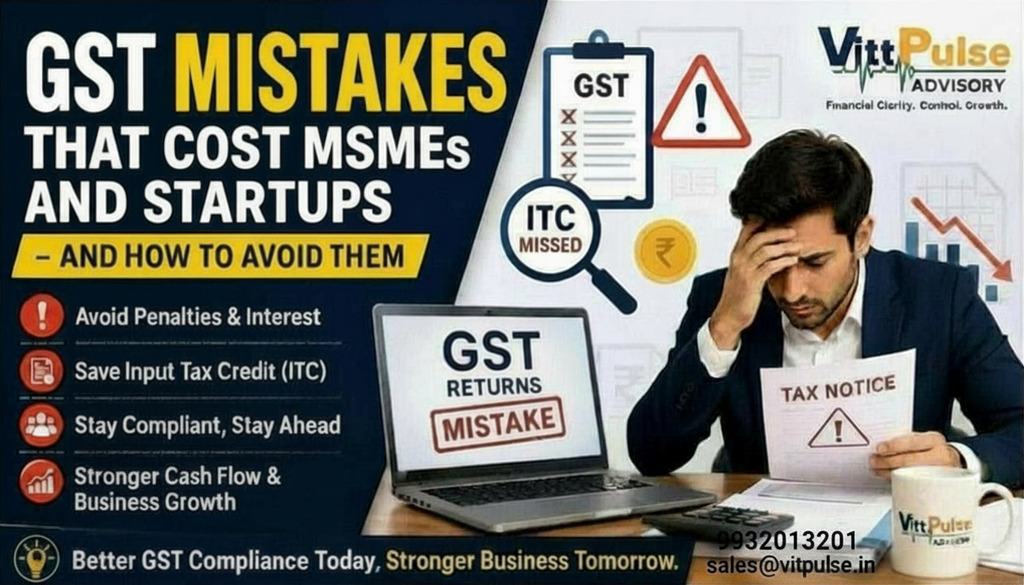
Many founders believe that once they have hired a CA or an accounting firm to file GST returns, their responsibility ends. Unfortunately, this assumption has resulted in thousands of businesses paying unnecessary interest, penalties, losing Input Tax Credit (ITC), and damaging customer relationships.
At Vittpulse Advisory, we regularly come across businesses where GST returns have been filed on time, but not correctly. The compliance appears perfect on paper, while the actual business transactions tell a very different story.
If you are an MSME founder or startup entrepreneur, understanding these common mistakes can save your business significant money and future litigation.
1. GST Compliance Is More Than Filing Returns
Every registered business has certain GST responsibilities depending upon its turnover and registration status. These include issuing GST-compliant invoices, maintaining books, timely payment of GST, filing GSTR-1 and GSTR-3B, reconciliation of ITC, annual return (GSTR-9), GSTR-9C where applicable, and preserving records.
GST compliance starts from recording the correct transaction—not from filing the return.
2. The Biggest Mistake – Blind Dependence on Outsourced Accountants
Many startups outsource GST compliance without any internal review. Filing based only on bank statements can result in missed invoices because GST is generally based on the time of supply, not receipt of payment.
Example: ABC Technologies raised an invoice of ₹12 lakh on 30 June. Payment came in July. If June GSTR-1 is prepared only from bank entries, the invoice is omitted. Result: unpaid GST, customer loses ITC, interest and notices.
Founders should periodically review sales invoices, credit/debit notes, advances, exports, reverse charge and exemptions.
3. Missing Even One Sales Invoice Can Become Expensive
If one sales invoice is omitted from GSTR-1, your business may face additional GST liability, interest and notices. Your customer cannot claim ITC because the invoice is absent from GST records, affecting their working capital and trust.
4. GSTR-2 Reconciliation – The Most Ignored Control
Monthly reconciliation between purchase records and auto-populated GST data helps identify missing supplier invoices, incorrect GSTIN, wrong values, duplicates and tax errors.
Example: Purchase register contains 100 invoices while GST portal reflects only 93. Without reconciliation, ITC on seven invoices may be lost until corrected.
5. GSTR-3B Is Not Just Another Return
Before filing GSTR-3B, verify sales, purchases, reverse charge, exports, adjustments and ITC. Incorrect filing can lead to excess or short payment, wrong ITC, interest and penalties.
6. Use IMS for Better GST Control
The Invoice Management System (IMS) allows businesses to accept, reject or keep supplier-uploaded invoices pending. It improves ITC accuracy, reduces disputes and strengthens monthly controls.
7. GSTR-9 and GSTR-9C – Annual Health Check
Annual GST returns help identify missed invoices, incorrect reporting, excess ITC and process weaknesses. GSTR-9C reconciles GST returns with financial statements where applicable.
8. What Should You Do If Bills Are Missed?
Identify omitted invoices, determine tax liability, make corrections as permitted under GST timelines, pay additional tax and interest where applicable, update books, inform customers if ITC is affected and strengthen internal controls.
9. How Vittpulse Advisory Helps
Vittpulse Advisory goes beyond return filing by reviewing business transactions, performing monthly reconciliations, validating GSTR-1 and GSTR-3B, optimizing ITC, conducting annual GST health checks, assisting with GST notices and building finance processes through Fractional CFO services.
Good GST compliance is not merely about avoiding penalties—it strengthens cash flow, customer confidence and long-term business growth.