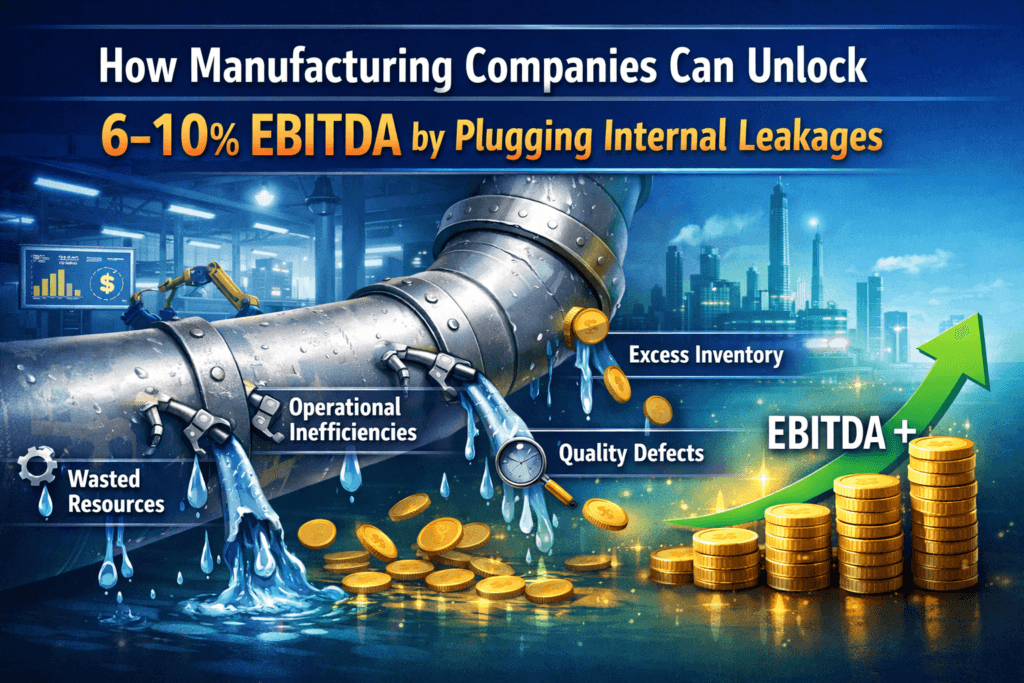
How Manufacturing Companies Can Unlock 6–10% EBITDA by Plugging Internal Leakages
A Strategic Playbook for ₹100–150 Cr Turnover Businesses
For many mid-sized manufacturing companies, growth follows a predictable journey—capacity expansion, onboarding new customers, and steadily improving top-line numbers. But once revenues cross the ₹100–150 Cr mark, a frustrating pattern often appears: sales grow, but profitability stalls.
Promoters usually attribute this to pricing pressure, volatile raw material costs, or rising competition. In reality, however, the biggest threat to margins is rarely external.
The real margin erosion happens inside the factory and back office.
At Vittpulse Advisory, we have repeatedly seen that 6–10% EBITDA improvement is possible without increasing sales, simply by fixing internal process leakages, governance gaps, and control weaknesses.
This article breaks down where profits leak, why founders don’t see it early, and how a structured IFC + SOP–driven approach can permanently plug these gaps.
Where Do Manufacturing Companies Lose Profits Internally?
The Invisible Profit Drain in Growing Manufacturing Businesses
Once a manufacturing company crosses ₹100 Cr in turnover, operational complexity increases sharply:
- Multiple vendors and suppliers
- Delegated procurement decisions
- Layered approval structures
- Decentralised stores and dispatch functions
- Informal controls still driving key decisions
On the surface, the business appears stable. Cash flows seem manageable. Operations look “under control.”
But beneath this stability, small inefficiencies quietly compound into large, recurring losses.
In our experience, these profit leakages consistently fall into six critical areas.
How Do Procurement Inefficiencies Impact EBITDA?
Procurement Inefficiencies & Hidden Kickbacks
Potential EBITDA impact: 1–2%
What We Commonly See
- Vendor rates accepted year after year without benchmarking
- No should-cost or comparative analysis
- Heavy reliance on “trusted” suppliers
- Purchases split to bypass approval thresholds
In one ₹120 Cr auto-components manufacturer, raw material prices for a key input were 7–9% higher than market benchmarks,and this went unnoticed for over three years. Procurement decisions were relationship-driven, not data-driven.
How IFC & SOPs Fix This
- Clear procurement authority matrix
- Mandatory rate comparison and vendor justification
- Segregation between indenting, approval, and vendor finalisation
- Periodic vendor rotation and benchmarking
Result:
- 1.5% EBITDA improvement within six months
- Elimination of kickback risks
- Strong audit trail and promoter confidence
Why Is Inventory Control So Weak in Manufacturing Companies?
Inventory Mismanagement & Store Leakages
Potential EBITDA impact: 1–1.5%
Inventory is often the largest balance-sheet item—and the weakest controlled.
Common Issues
- Excess raw material kept “just in case”
- Obsolete and slow-moving inventory never reviewed
- Manual stock records not matching physical stock
- Store teams operating without effective checks
A ₹140 Cr FMCG manufacturer was found to be carrying ₹6.8 Cr of dead and non-moving inventory, uncovered only during a strategic review. Audits existed—but accountability didn’t.
System-Led Solution
- ABC and FSN inventory classification
- SOPs for receipt, storage, issue, and reconciliation
- Monthly stock ageing and variance reporting
- Surprise physical verification under an IFC framework
Result:
- Inventory reduced by ₹4 Cr
- Significant working capital release
- Lower pilferage and write-offs
How Do Scrap and Rework Reduce Manufacturing Margins?
Production Losses: Scrap, Rework & Downtime
Potential EBITDA impact: 2–3%
Many promoters treat scrap and rework as “part of manufacturing.” That mindset is expensive.
What We Identify
- Scrap norms undefined or outdated
- Rework not tracked by department
- Downtime reasons neither logged nor analysed
In a process manufacturing unit, actual scrap levels were 1.9% higher than standard, translating into a ₹2.4 Cr annual loss—hidden inside production numbers.
Control Through SOPs & MIS
- Defined standard loss norms
- Department-wise accountability
- Daily production variance dashboards
- Root-cause analysis as a discipline
Result:
- 2% EBITDA improvement
- Better plant discipline
- Predictable output and accurate costing
How Do Theft and Dispatch Errors Affect Profitability?
Potential EBITDA impact: 0.5–1%
This is one of the most sensitive—and most ignored—areas.
Ground Reality
- Dispatch shortages leading to credit notes
- Material loss during internal movement
- Weak gate controls
- No maker-checker system at dispatch
One engineering goods manufacturer was issuing ₹1.2 Cr annually in credit notes due to delivery shortages—mistakenly assumed to be logistics errors.
IFC-Driven Controls
- Segregation of packing, billing, and dispatch
- Weighment and dispatch SOPs
- CCTV-linked audit checkpoints
- Defined approval hierarchy for credit notes
Result:
- Credit notes reduced by 60%
- Zero-tolerance culture established
- Improved customer trust
Why Do Profitable Companies Still Face Cash Flow Issues?
Potential EBITDA impact: 1–2%
High sales do not automatically translate into strong cash flows.
Typical Symptoms
- Ad-hoc credit approvals
- No ownership for collections
- Ageing reports prepared but ignored
In a ₹110 Cr B2B manufacturing company, ₹9 Cr was stuck beyond 120 days, increasing borrowing costs and straining promoter liquidity.
Structural Fix
- Credit policy SOP
- Customer-wise credit limits
- Receivable ageing accountability
- Escalation triggers for overdue accounts
Result:
- Reduction in debtor days by 20–30
- Lower interest costs
- Stronger cash discipline
Why Founders Don’t See These Leakages Early
Vittpulse Advisory: Strategic Advisors to Manufacturing Founders
At Vittpulse Advisory, we partner with promoters of ₹100–150 Cr manufacturing companies to:
- Diagnose profit leakages across the value chain
- Design and implement robust IFC frameworks
- Create practical, executable SOPs (not theoretical manuals)
- Build real-time MIS and accountability
- Strengthen governance without slowing operations
Our approach is execution-first, not report-heavy.
We don’t just identify issues—we stay involved until improvements are visible in EBITDA.
What Happens When Manufacturing Businesses Plug Internal Leakages?
Companies that institutionalise systems over individuals achieve:
- Sustainable margins
- Reduced dependency on key people
- Lower fraud and leakage risks
- Higher valuation and investor confidence
Most importantly, founders move from constant firefighting to strategic leadership.
Conclusion
If your company is doing ₹100–150 Cr in revenue but margins feel stuck, the solution isn’t more sales,it’s better control.
The profits you’re chasing are already inside your business.
They just need to be identified, protected, and institutionalised.
Vittpulse Advisory , Strategic Advisors to Manufacturing Founders
Plug leakages. Strengthen systems. Build enduring profitability.
Investing in financial leadership early is one of the smartest decisions a startup can make.
Frequently Asked Questions (FAQs)
Can manufacturing companies really improve EBITDA without increasing sales?
Yes. Mid-sized manufacturing companies can unlock 6–10% EBITDA improvement without any sales growth by fixing internal inefficiencies. Most margin losses come from procurement gaps, inventory mismanagement, production losses, weak controls, and receivable slippages—not from market conditions. Strengthening internal controls and SOPs directly improves profitability.
What are the most common internal profit leakages in manufacturing businesses?
The most common profit leakages occur in:
- Procurement inefficiencies and vendor dependency
- Excess and obsolete inventory
- Scrap, rework, and production downtime
- Theft, pilferage, and dispatch shortages
- Poor receivables management and working capital controls
Individually these look small, but together they significantly erode EBITDA.
Why don’t promoters identify these leakages at an early stage?
Promoters often miss these leakages because losses are spread across departments, hidden inside aggregated reports, and treated as “normal operations.” Without a single dashboard showing profit leakage and accountability at process level, inefficiencies become institutionalised and invisible over time.
How do IFC frameworks and SOPs help improve manufacturing profitability?
IFC frameworks and SOPs introduce clear accountability, segregation of duties, audit trails, and real-time monitoring. They replace person-driven decisions with system-driven processes, reducing leakage, fraud risk, and operational uncertainty—leading to predictable margins and stronger governance.
When should a manufacturing company bring in a strategic advisor?
A strategic advisor becomes critical when revenues cross ₹100 Cr, complexity increases, and margins stagnate despite growth. Unlike traditional consultants, a strategic advisor focuses on execution, implementation, and measurable EBITDA impact, not just diagnostic reports.