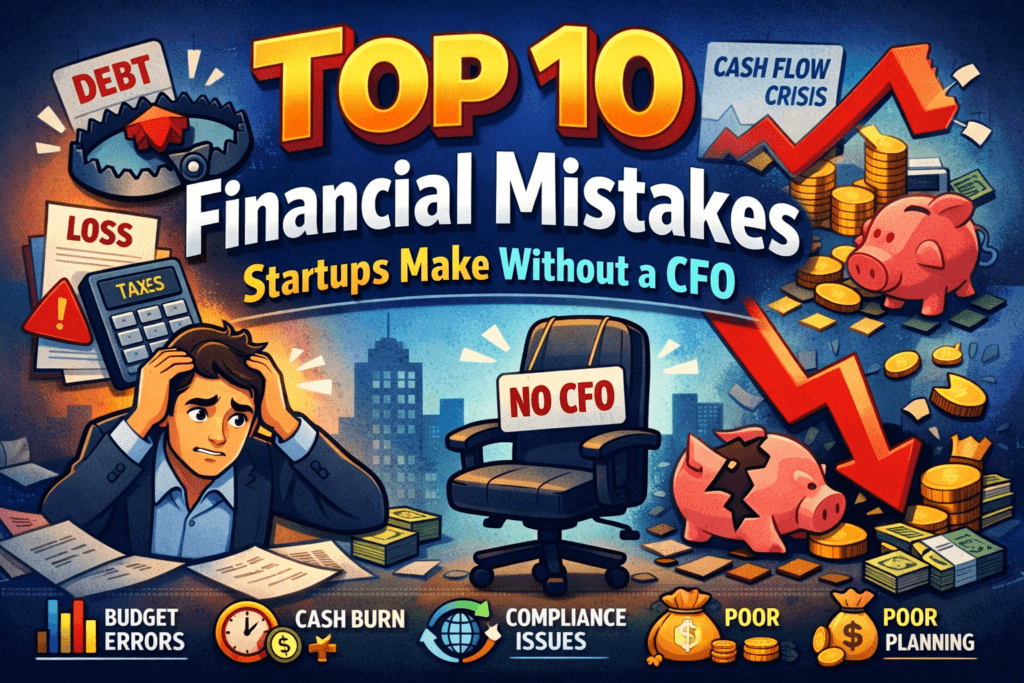
Top 10 Financial Mistakes Startups Make Without a CFO
Did you know that nearly 38% of startups fail because they run out of cash, according to multiple industry studies? While founders often blame product-market fit or competition, the real issue is frequently poor financial management. Many startups focus heavily on innovation, marketing, and growth—but overlook the importance of strong financial leadership.
This is where most startup financial mistakes begin.
Without a CFO for startups, founders are forced to juggle finances alongside operations, sales, and fundraising. As a result, critical areas like cash flow planning, financial forecasting, tax compliance, and investor reporting often get neglected. These gaps don’t show up immediately—but when they do, the damage can be fatal.
In this guide, we’ll break down the most common startup financial mistakes, explain why financial leadership matters, and show practical solutions—from hiring a CFO to using fractional CFO services. Whether you’re pre-revenue or scaling fast, understanding startup financial management can be the difference between long-term success and early failure.
Why Startups Need Financial Leadership
The Role of a CFO in Startup Growth
A common misconception is that a CFO only manages accounting or bookkeeping. In reality, a Chief Financial Officer plays a strategic role in guiding startup growth.
Key CFO responsibilities include:
- Strategic financial planning, not just expense tracking
- Financial forecasting and modeling to guide decisions
- Cash flow optimization and runway management
- Investor relations and fundraising support
- Translating financial data into actionable insights
Unlike bookkeepers, CFOs help founders answer critical questions like:
- How fast can we grow without running out of cash?
- Are our unit economics sustainable?
- When should we raise our next funding round?
This kind of startup finance strategy becomes essential once growth accelerates.
When should a startup hire a CFO?
Most startups don’t need a full-time CFO on day one. However, CFO-level guidance becomes critical when:
- Revenue approaches $1M annually
- You’re preparing for seed or Series A funding
- Cash flow becomes unpredictable
- Financial decisions impact long-term valuation
At this stage, startups usually choose between:
- Fractional CFO (part-time, cost-effective)
- Full-time CFO (expensive but deeply involved)
A fractional CFO for startups often delivers the best cost-benefit ratio during early growth.
Critical Financial Mistakes Startups Make Without a CFO
1. Poor Cash Flow Management
Cash flow issues are the number one reason startups fail.
Common mistakes include:
- Not tracking cash runway
- Assuming profitability equals cash availability
- Failing to maintain emergency reserves
Many founders misunderstand the difference between cash flow vs. profit. A startup can be profitable on paper and still run out of cash.
2. Inadequate Financial Forecasting and Planning
Operating without financial projections is like driving blindfolded.
Mistakes include:
- No monthly or quarterly forecasts
- Unrealistic revenue assumptions
- No downside or worst-case planning
This directly affects:
- Fundraising credibility
- Hiring decisions
- Inventory and expansion plans
Should I separate personal and business finances?
Absolutely. Mixing finances leads to:
- Tax compliance issues
- Legal liability risks
- Confusing financial records
- Lower investor trust
Best practices:
- Separate bank accounts
- Dedicated business credit cards
- Clear reimbursement policies
This simple step protects both the founder and the company.
Many startups underestimate tax complexity.
Common startup tax mistakes include:
- Missing filing deadlines
- Misclassifying contractors vs employees
- Ignoring payroll and sales tax rules
Penalties, audits, and legal issues can derail momentum fast
Burn rate is how fast your startup spends cash.
Mistakes include:
- Overspending before revenue stability
- Scaling too fast
- Ignoring CAC and unit economics
A healthy startup aligns cash burn management with growth milestones.
6. Poor Pricing Strategy
Under-pricing is more dangerous than over-pricing.
Problems include:
- Not accounting for full cost structure
- Copying competitor pricing blindly
- Failing to adjust pricing as value increases
A weak pricing strategy limits profitability—even with strong demand.
7. Lack of Financial KPIs and Metrics Tracking
What financial metrics should startups track?
Without metrics, decisions are guesswork.
Key startup financial KPIs include:
- Gross margin
- CAC and LTV
- Burn rate
- Churn rate
- Monthly recurring revenue (MRR)
Dashboards turn numbers into decisions.
8. Inefficient Capital Allocation
Poor capital allocation leads to wasted resources.
Mistakes include:
- Investing without ROI analysis
- Overfunding low-impact departments
- Ignoring long-term sustainability
9. Inadequate Financial Documentation for Fundraising
What financial documents do investors require?
Investors expect:
- Clean financial statements
- Cash flow forecasts
- Cap tables
- Unit economics breakdowns
Messy records signal risk and reduce valuation.
10. Failing to Plan for Taxes and Year-End Obligations
Year-end surprises hurt cash flow.
Common issues:
- Unexpected quarterly tax bills
- Missed deductions
- Ignoring R&D tax credits
Growth Indicators That Require CFO Expertise
At what revenue should a startup hire a CFO?
Typically:
- $1M+ annual revenue
- Preparing for Series A
- Market expansion
- Increased operational complexity
Affordable CFO Solutions for Early-Stage Startups
Fractional CFO Services
Benefits:
- Lower cost
- Strategic insights
- Flexible engagement
Virtual CFO and Financial Consultants
Ideal for remote teams, offering:
- Forecasting
- Compliance oversight
- Fundraising prep
CFO Software and Financial Management Tools
Popular tools:
- Accounting: QuickBooks, Xero
- Planning: Finmark, Jirav
Dashboards: Real-time analytics
Building Financial Discipline Without a Full-Time CFO
Essential Financial Practices for Founders
- Monthly financial reviews
- Basic forecasting models
- Strong accounting systems
- Finance-first culture
Bookkeepers track history.
CFOs shape the future.
Knowing this difference prevents long-term damage.
Case Studies: Startups That Suffered Without CFO Oversight
Many failed startups shared common issues:
- Poor cash planning
- No forecasting
- Weak compliance
Successful turnarounds almost always involved strong financial leadership.
Conclusion
Most startup failures aren’t caused by bad ideas, they’re caused by avoidable financial mistakes. From poor cash flow management to weak forecasting and tax surprises, the absence of CFO-level leadership leaves startups exposed at critical growth stages.
Strong financial leadership doesn’t always mean hiring a full-time CFO. Fractional CFO services, virtual CFOs, and modern financial tools provide affordable access to strategic guidance.
If you’re a founder, the next step is simple:
- Assess your startup’s financial health
- Identify gaps in forecasting, cash flow, and compliance
- Consider CFO-level support before problems escalate
Investing in financial leadership early is one of the smartest decisions a startup can make.
Frequently Asked Questions (FAQs)
What is the difference between a CFO and a bookkeeper?
A bookkeeper handles day-to-day transaction recording and basic financial tasks, while a CFO provides strategic financial leadership, including forecasting, fundraising support, financial planning, and advising on major business decisions. CFOs analyze data and drive strategy; bookkeepers process transactions.
Can a startup afford a CFO in the early stages?
Most early-stage startups cannot afford a full-time CFO (typically $150K-$300K+ annually). However, fractional or part-time CFO services (starting at $2K-$10K monthly) provide affordable access to CFO-level expertise without the full-time cost, making strategic financial guidance accessible even for pre-revenue startups.
What are the biggest financial red flags investors look for?
Investors watch for poor cash flow management, unrealistic financial projections, lack of understanding of unit economics, inconsistent or messy financial records, high burn rate without clear path to profitability, and founders who cannot articulate key financial metrics. These red flags often lead to failed fundraising attempts.
How do I know if my startup's burn rate is too high?
Your burn rate is concerning if: you have less than 6 months of runway, you’re spending faster than planned without corresponding revenue growth, your customer acquisition costs exceed lifetime value, or you’re unable to project when you’ll reach profitability. A healthy burn rate aligns with growth milestones and fundraising timeline.
What financial metrics should every startup founder track monthly?
Essential metrics include: cash runway (months until you run out of money), burn rate (monthly cash spent), revenue growth rate, gross margin, customer acquisition cost (CAC), customer lifetime value (LTV), CAC/LTV ratio, monthly recurring revenue (MRR for SaaS), and churn rate. These metrics provide visibility into financial health and growth sustainability.